
Before I write a little about Jayne Mansfield, I need to explain how all of this began.
I first discovered Marilyn Monroe as a child in the 1970s while rummaging through a stack of old hardcover books in my grandparents’ attic. Most of them held little interest for me, but two were “year in review” volumes—either 1955 and 1956, or possibly 1954 and 1955. Skimming through the entertainment sections, I came across photos of Marilyn in The Seven Year Itch, and that was it—I was hooked.
This was long before the internet, before Google or Bing, so learning about Marilyn meant tracking down gossip magazines or the occasional book. Those sources focused almost exclusively on her, rarely mentioning the other actresses studios were grooming as their own versions of Marilyn. As a result, I knew almost nothing about the so-called “Marilyn clones.”
A few years later, picture this: a girl—about ten or eleven—standing in a grocery store, flipping through a magazine while waiting for her parents to finish shopping. In it, she stumbles upon a small article about a blonde actress from the 1950s named Jayne Mansfield. What caught her attention wasn’t Hollywood gossip, but two simple facts: Jayne was born in Pennsylvania, and she was buried there too. That detail alone was enough. From that moment on, Jayne’s name stayed with me. I was determined to learn everything I could about her—and someday, to visit her grave. And yes, that girl was me. 🙂
At the time, information about Jayne was scarce. Few books had been written, and gossip magazines only mentioned her in connection with her tragic death or her association with Anton LaVey, usually when they needed a sensational headline.
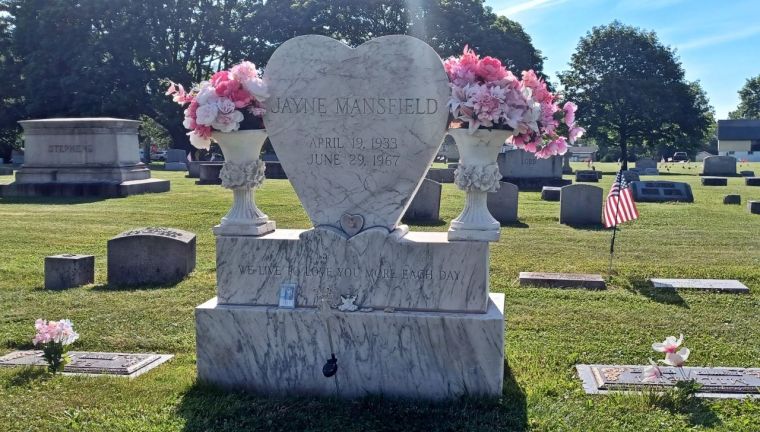
I was in my late twenties when I finally made my first trip to Pen Argyl, Pennsylvania, to visit her grave at Fairview Cemetery. The cemetery is quiet and tucked away—an unlikely resting place for a woman who thrived on glamour, hype, and Hollywood spectacle. But after her death on June 29, 1967, her second husband, Mickey Hargitay, who was divorced from her at the time, was given custody of her body. He and/or Jayne’s mother chose Fairview Cemetery. Hargitay later said that he and Jayne had visited the cemetery during their courtship and that she had remarked on how much she liked it.
In a way, it makes sense. Jayne is buried in the Palmer family plot, near her father, who died when she was very young—a loss many believe deeply affected her throughout her life. In death, she was reunited with him after decades apart, and there’s something quietly fitting about that.
Jayne’s funeral drew the expected crowd: devoted fans, curious onlookers, and people hoping to glimpse a famous face. No major Hollywood figures attended. Even Matt Cimber, whom Jayne was married to at the time of her death, did not attend. Publicly, it was said he didn’t want to upset Jayne’s mother, but as noted in Jayne Mansfield and the American Fifties by Martha Saxton, the reality was far colder—he simply did not care. Their relationship had already deteriorated into a bitter divorce and custody battle, which he ultimately lost.
Hargitay handled the burial arrangements and purchased the large, heart-shaped gravestone that marks her resting place today. It stands out among the other markers in the cemetery—and somehow, that feels appropriate. Jayne always stood out.
There are those who argue that Jayne was never truly a “star,” only a celebrity. They point to her limited box-office success, her marriages and affairs, her relentless pursuit of publicity, and her willingness to appear at store openings rather than cultivating Hollywood’s inner circles. But that argument misses something important. Jayne understood attention, image, and spectacle—and she played that game unapologetically.
Today, there’s no shortage of books, articles, and websites detailing every aspect of her life, career, and death. I’m not here to rehash all of that. This is simply the story of how I came to discover Jayne Mansfield—and how, once again, childhood curiosity turned into a lifelong connection.
 Planet Graple