
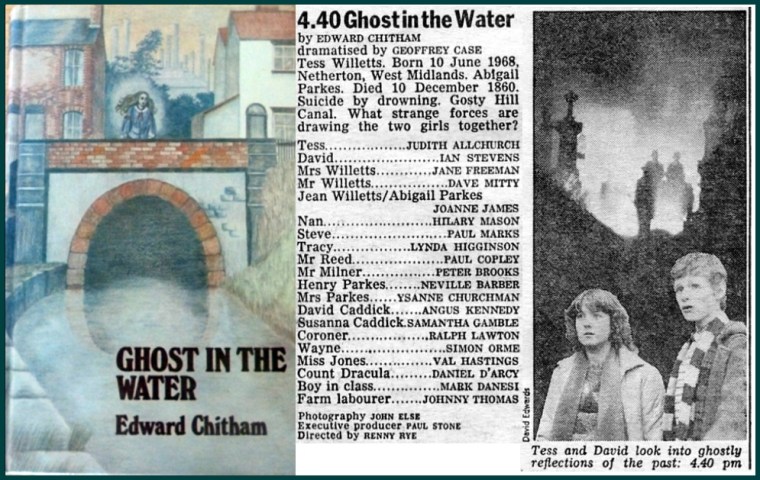
Book: Ghost in the Water
Author: Edward Chitham
Published: 1973
Book Plot: Teresa and David, school kids, read an interesting inscription on a gravestone in the local churchyard; In memory of Abigail Parkes. Departed this life 10th December 1860. Aged 17. Innocent of all harm.” Teresa recalls that hanging on the wall at her home is a sampler created by the deceased girl when she was 11. This fact combined with the strange epitaph will soon embroil the friends in a century old mystery involving a ghost of a girl who had drowned.
Mini Author Bio: Discover the captivating world of British history with Frank Chitham, a celebrated historian and author. Frank’s meticulously researched books bring to life the intriguing stories of monarchs and medieval times, offering a fresh perspective on figures like Richard III and Henry VII. What makes Frank’s work stand out is his talent for making complex historical debates easy to understand and enjoy, without sacrificing academic rigor. By drawing on reliable primary sources, he weaves together a rich and vibrant narrative that’s accessible to readers from all walks of life. With Frank, history becomes a fascinating journey of exploration, rather than just a dry recitation of dates and events.
Interesting Notes: Was made into a one hour television movie in England in 1982. You might be able to find it on YouTube. Also of note, is starred Jane Freeman (possibly best known as Ivy of Last of the Summer Wine).
Interesting Words & Things
Below are interesting words used and other things mentioned in the book.
Swot: a person who studies very hard
Sampler: a piece of embroidery worked in various stitches as a specimen of skill, typically containing images,a line from a poem or scripture and they would usually include their name, also
Gorse: a spiny yellow-flowered European shrub (Ulex europaeus) of the legume family broadly
Lych gate: a roofed gate in a churchyard under which a bier (tangled mass of plants) rests during the initial part of the burial service. (Sometimes spelled lich. A lych is a corpse, a dead body).
Daimler: Daimler was a high-end car brand made in Coventry, England. The company started back in 1896 and took its name from German engineer Gottlieb Daimler. Over the years, Daimlers came to be seen as cars for the upper class in Britain and were especially associated with the royal family, who owned several of them.
Verger: an official in some churches who takes care of the inside of a church building and performs some simple duties during services. Example of a duty performed: carrying a rod or staff that has an emblem of authority or symbol of office such as that used of an Archbishop.
Vestry: A room in a church where sacred vessels and vestments are kept or meetings are held
Anorak: a short coat that protects the wearer against wind, rain, and cold weather, usually with a part for covering the head. In the US it is called a parka. The word can also be used to describe a person who is extremely enthusiastic about and interested in something that other people find boring
Adam Bede: Book written by George Eliot. Adam Bede tells the story of a moral carpenter whose life is upended by love, betrayal, and tragedy in a rural English village, ultimately exploring guilt, compassion, and redemption.
Saft: Scottish variant on the word “soft”.
Frowsty: having an unpleasant smell because of having no fresh air
Some Back Story to the Story
Knowing that Edward Chitham was a historian made me wonder whether his book was rooted in a real event. I wasn’t surprised to discover that it was inspired by the April 1899 drowning of Mary Ann Girling, a 34-year-old working-class mother of five who fell into the Dudley Canal in Tipton, England, and drowned. The coroner’s report, newspaper accounts, and census records paint a stark and sobering picture. She was not a romantic, jilted lover in a flowing white gown, but a wife and mother living a difficult life in a harsh industrial town. Her death was a tragic yet ordinary accident—one that would have devastated her family and community.
As time passed, however, the story began to change. Details were added, reshaped, and embellished, until it slowly transformed into a classic Victorian Gothic tragedy. In later tellings, a woman dressed in white was said to rise from the canal’s depths. Some versions claimed she was searching for a lost child; others cast her as a jilted lover, condemned to relive the final, sorrowful moments of her life again and again. In that way, a simple human tragedy evolved into legend, blurring the line between history and haunting folklore.
Interesting Side Note
It’s important not to confuse our Mary Ann Girling with another, far more famous woman of the same name. This Mary Ann Girling was a 19th-century English religious figure often described as a fanatic, who convinced a small but devoted group of followers—later known as the Girlingites—that she was the Messiah. She eventually became the leader of the Hordle Shakers and died in 1886, more than a decade before the Mary Ann Girling connected to the canal tragedy.
The two women share a name, but beyond that, their lives—and legacies—could not be more different.
 Planet Graple